The 30-Piece Executive Wardrobe No. 3
The Navy Blazer

There are garments that signal wealth, trend, or taste. And then there are garments that signal competence. The navy blazer belongs in the second category.
It functions less like clothing and more like a strategic tool. It provides a uniform when a suit would be excessive, credibility when business casual collapses into ambiguity, and authority without resorting to flash.
If the modern professional wardrobe has a load-bearing beam, this is it.
Why the Navy Blazer Matters

In environments where the dress code is poorly defined, the navy blazer resolves the uncertainty.
Worn correctly, it communicates three traits that matter in high-context professional settings:
Intention. You took the meeting seriously.
Competence. You can read a room.
Neutrality. You’re not performing. You’re working.
For executives and aspirational professionals alike, this is the quiet advantage—especially in rooms where “business casual” has been misinterpreted into denim, sneakers, and tech-company fleece.
What a Navy Blazer Is (and Isn’t)

A proper navy blazer is not a suit jacket worn separately. The distinction is important.
A suit jacket is designed to match its trousers. A blazer is designed to stand apart.
The details make this clear:
— Hopsack or high-twist weaves instead of smooth worsteds
— Patch or welt pockets instead of only jetted pockets
— Horn, metal, or tonal buttons depending on the level of formality
— A silhouette cut for layering, mobility, and contrast
This contrast is the core of its usefulness.
Fit: The Executive Non-Negotiable
Executives do not impress by wearing expensive clothes. They impress by wearing well-fitted clothes.
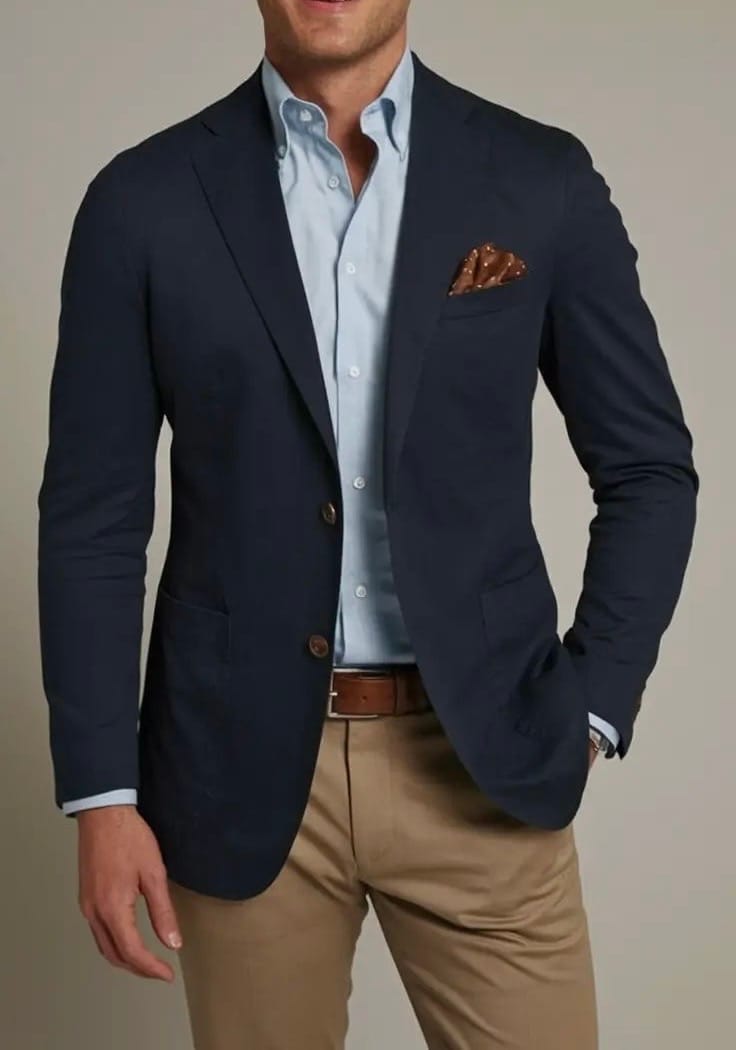
A correct blazer fit is quiet and almost invisible. The absence of errors is the signal.
Key non-negotiables:
— Shoulders align with the natural shoulder line
— Chest is clean but not tight
— Waist is suppressed but not aggressive
— Armholes sit higher than mall-level tailoring
— Jacket length hits at mid-crotch, not cropped
— Sleeve length permits ¼–½ inch of shirt cuff
— Sleeve pitch matches the wearer’s natural arm position
Many professionals would look considerably more senior overnight if they tailored their jackets and shoes before touching anything else.
Color Strategy
Navy is the wardrobe’s most cooperative color. It pairs with charcoal, mid-grey, cream, olive, stone, and denim. It travels across industries without needing translation.
Black is too formal. Grey lacks initiative. Brown is contextual. Navy threads the needle.
This universality is why the navy blazer is standard in finance, law, consulting, public policy, and private equity—but also acceptable in media, design, and tech when properly styled.
Seasonal Variants
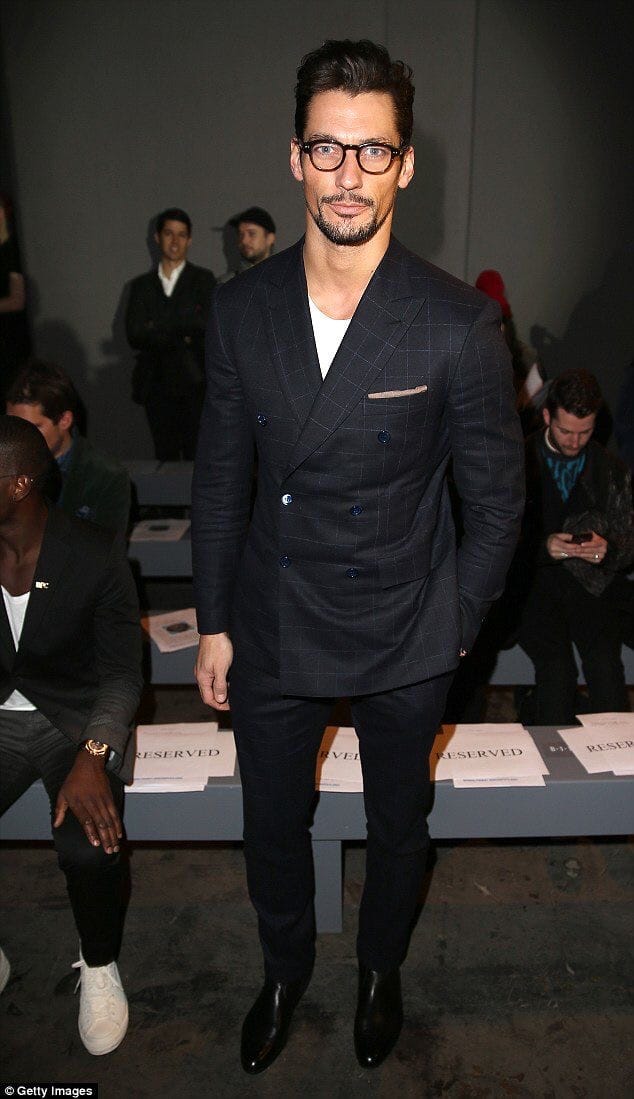
The blazer is not a single item. It is a category with subtypes:
Spring / Summer
— Tropical wool
— Fresco
— High-twist wool
— Cotton twill
— Linen (less formal)
Fall / Winter
— Worsted wool
— Wool flannel
— Cashmere or cashmere blends
— Brushed wools
— Tweed (informal, but useful)
For most readers, the optimal starting point is a navy high-twist or hopsack blazer in a three-season weight (8.5–10oz). It breathes, travels, resists wrinkles, and maintains structure.
Use-Cases and Pairings
Professionals do not buy clothing for aesthetic interest alone. They buy for scenario coverage.
The navy blazer covers more scenarios per dollar than nearly any other tailored garment:
Investor meetings, client lunches, partner reviews
Pair with charcoal or mid-grey trousers.

Travel days, conferences, cross-functional work sessions
Pair with stone, taupe, or olive chinos.
Dinners, informal networking, intellectual venues
Pair with dark denim and a crisp shirt or fine-gauge knit.
This is not about fashion versatility. It is about contextual fluency.
Buttons, Pockets, and Material Notes
Small details create the difference between “preppy,” “corporate,” and “modern executive.”
Button choices:
— Dark horn: universally appropriate
— Metal: classic, slightly maritime, more traditional
— Tonal: minimal and contemporary
Pocket configuration:
— Welt pockets: clean and formal
— Patch pockets: relaxed and Continental
Material observations:
— Hopsack drapes cleanly and resists wrinkles
— High-twist wool is the traveler’s best friend
— Poly blends should be avoided altogether
If the goal is a long-term wardrobe, buy natural fibers and tailor them.
Common Errors
The most frequent errors among professionals:
— Wearing a suit jacket as a blazer
— Buying cropped, fashion-forward cuts
— Settling for low armholes and bulky padding
— Pairing with distressed denim
— Synthetic or shiny fabrics
— Inappropriate buttons for the environment
Most of these errors stem from buying for trend rather than for context and longevity.
Strategic Conclusion
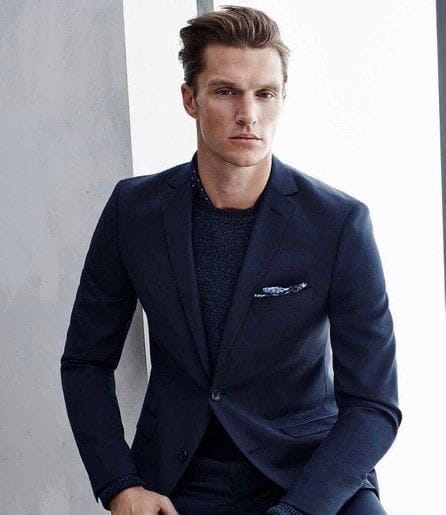
The modern wardrobe does not need volume. It needs clarity.
The navy blazer offers clarity in environments that lack it. It communicates seriousness without rigidity, capability without spectacle, and preparedness without self-consciousness.
It is the third essential in a 30-piece executive wardrobe because it solves more problems than it creates.
Issue No. 4 is next.
About This Series
The 30-Piece Executive Wardrobe is a serialized guide for modern professionals who want to look serious, composed, and credible in environments where those traits are increasingly rare.
Each issue focuses on a single item, framed not as fashion, but as a tool—evaluated by utility, context, and long-term wearability.
For Readers Who Asked About Advisory and Corporate Programs
Executive style advisory, onboarding materials, and institutional licensing are available for firms in law, finance, consulting, and wealth management who want elevated dress codes without the usual ambiguity.
For private or institutional inquiries: