The 30-Piece Executive Wardrobe No. 27
The Dress Watch
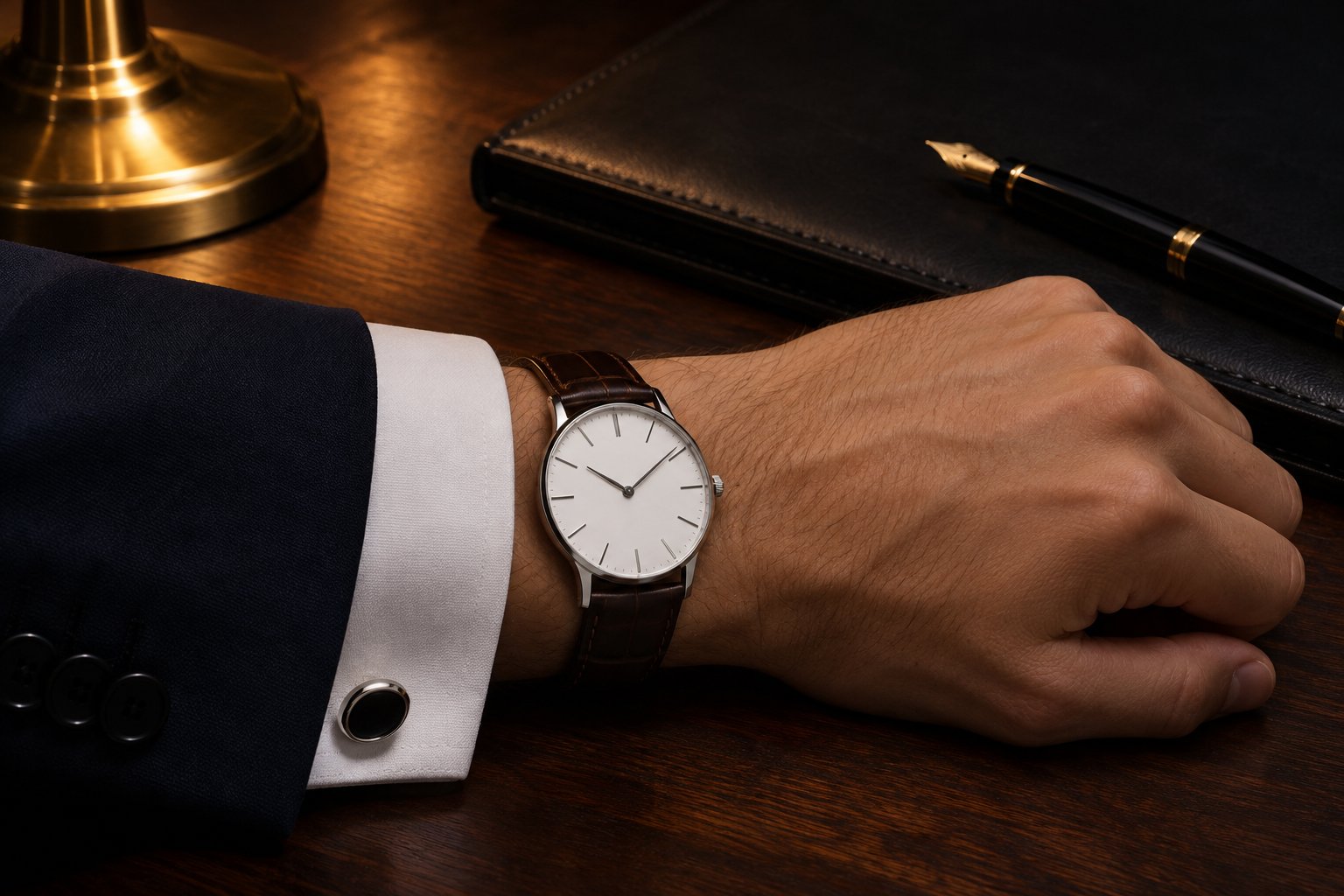
A man's watch is read before he speaks.
Not the brand. Not the price.
The choice.
Across the table, a client notices the wrist the way they notice the shoes. Quietly. Instantly. And they draw a conclusion.
The dress watch exists to make that conclusion simple: this man pays attention.
Why the Dress Watch Matters
Most men wear the wrong watch to work.
Too large. Too loud. Too much going on.
A dive watch with a rubber strap. A smartwatch lighting up mid-meeting. A heavy chronograph that catches on every cuff.
Each one works somewhere. None of them belong with a suit.
The dress watch solves this by doing less. It tells the time, and it lets the rest of you do the talking.
The Executive Advantage
A proper dress watch does three things for a professional wardrobe:
- It finishes the suit. It slips under the cuff and shows only when you move.
- It signals discipline. Restraint at the wrist reads as restraint everywhere.
- It removes the phone from the table. Checking the time on your wrist is a glance. Checking your phone is an interruption.
What Makes a Dress Watch
Keep it simple. Look for:
- Case size: 36–40mm. Smaller than you think. It should sit inside the wrist, not hang over it.
- Case thickness: Slim enough to slide under a shirt cuff. Under 10mm is ideal.
- Dial: White, cream, silver, or deep navy. Plain markers. Nothing busy.
- Complications: Few or none. Time only, or a small date window at most.
- Case metal: Polished steel is the workhorse. Gold is a statement; choose it deliberately.
Strap: Leather First
The strap does as much work as the watch.
Dark brown leather
Best for:
- Navy and charcoal suits
- Brown shoes
- Daily wear
Black leather
Best for:
- Black shoes
- Evening events
- The most formal settings
The rule is old and still right: match the strap to the shoes. Close enough is fine. Opposite is not.
A steel bracelet works for business casual. With a suit, leather wins.
The Proper Fit
- The watch sits just above the wrist bone.
- The shirt cuff covers it when your arm is at rest.
- It shows when you reach, gesture, or shake a hand.
- The strap is snug. It should not slide around your wrist.
If the cuff can't close over the watch, the watch is too thick or the cuff is too tight. Fix one of them.
What the Dress Watch Communicates
Composure.
Taste without effort.
A man who doesn't need the room to notice him.
It's the opposite of a status symbol. It's a standard.
Common Mistakes
- Going too big. Oversized cases look like costume next to tailoring.
- Wearing the sport watch with everything. One watch cannot do every job.
- Letting the strap wear out. A cracked, faded strap undoes a good watch. Replace it.
- Stacking. A watch and a bracelet and a fitness band is three things too many.
Investment Pieces Worth Considering
Good dress watches exist at every budget. None of these rely on oversized logos:
- Entry: Seiko, Orient, Timex Marlin
- Middle: Hamilton, Tissot, Junghans, Baltic
- Investment: Longines, Nomos, Grand Seiko
- Heirloom: Cartier Tank, Jaeger-LeCoultre Reverso, Omega De Ville
Buy the best one you can afford once, and wear it for twenty years.
Final Thought
The dress watch is not loud.
It does not compete with the suit.
It does not ask to be admired.
It simply confirms what everything else already said.
Quiet. Precise. Considered.
Next in the series: The Haircut.